
Content Marketing: The Digital Real Estate You Can’t Afford to Ignore
- Social Base
- Nov 24, 2025
- 3 min read


Introduction: Stop Selling, Start Helping
In a world where the average person sees thousands of advertisements every single day, we have become experts at tuning out the noise. We skip TV commercials, we pay for ad-free streaming, and we scroll past the "Sponsored" posts on our feeds.
So, how does a business capture attention in this crowded marketplace?
The answer isn't to shout louder. The answer is to whisper something valuable. This is the essence of Content Marketing. It is the art of communicating with your customers and prospects without explicitly selling to them. Instead of pitching your products or services, you are delivering information that makes your buyer more intelligent.
What is Content Marketing?
Content marketing is a strategic marketing approach focused on creating and distributing valuable, relevant, and consistent content to attract and retain a clearly defined audience — and, ultimately, to drive profitable customer action.
Think of it this way:
Traditional Advertising is like renting attention. You pay for a billboard or a TV spot, and when you stop paying, the attention stops.
Content Marketing is like owning the building. When you create a helpful blog, an informative YouTube video, or a market analysis report, that asset belongs to you. It continues to work for you, 24/7, building trust with your audience long after you’ve hit "publish."
Why Content is "King" in 2025
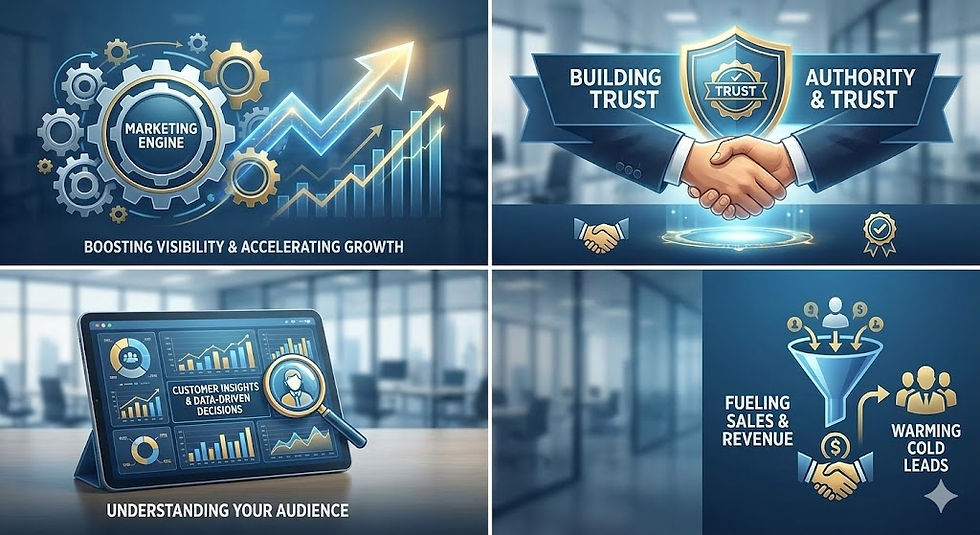
1. It Builds Trust and Authority
People buy from businesses they trust. When you provide free, high-quality information—like explaining complex government housing schemes or breaking down market trends—you position your brand as an industry leader. You aren't just a vendor; you become a partner in their journey.
2. It Fuels Your SEO (Search Engine Optimization)
Google loves fresh, relevant content. When you consistently publish articles and videos that answer the questions your customers are asking (e.g., "Best affordable housing in Lucknow" or "LDA latest updates"), you climb the search rankings. This brings organic, high-quality traffic to your website without paying for clicks.
3. It Educates Your Customer
An educated customer is the best customer. By the time a lead contacts you after consuming your content, they already know who you are, they understand the market, and they trust your expertise. This shortens the sales cycle significantly.
The 3 Pillars of a Great Strategy
To succeed, you need more than just random posts. You need a strategy:
Video Content: In the age of Instagram Reels and YouTube, video is non-negotiable. Whether it's a site tour or a news update, video builds a personal connection that text cannot.
Consistency: One viral post won't build a business. Regular, reliable updates (like "The Real Update") create a habit for your audience. They start to rely on you for information.
Distribution: Creating content is only half the battle. You must distribute it across the right channels—LinkedIn for professionals, YouTube for detailed explanations, and Instagram for visual impact.
Mapping Content to the Buyer’s Journey
Content isn't one-size-fits-all. A person just starting to think about buying a home needs different content than someone ready to sign a cheque. You must create content for every stage of the funnel:
Stage 1: Awareness (The "I have a problem" phase)
The customer knows they need a change but doesn't know you exist.
Goal: Solve a general problem.
Content Examples: "Rent vs. Buy: What is better in 2025?" or "Top 5 Developing Areas in Lucknow."
Format: Blog posts, short social media videos, infographics.
Stage 2: Consideration (The "I am researching solutions" phase)
The customer knows they want to buy property and is comparing options.
Goal: Show why your solution/area is superior.
Content Examples: "LDA Housing Schemes vs. Private Builders: A Comparison" or "Pros and Cons of Living in Sharda Nagar."
Format: Detailed YouTube reviews, Webinars, E-books/Guides.
Stage 3: Decision (The "I am ready to buy" phase)
The customer is ready to choose a partner.
Goal: Validate their trust in you.
Content Examples: Customer testimonials, "Day in the Life" of your team, specific project walkthroughs.
Format: Case studies, One-on-one consultation offers, Live Q&A sessions.
Tools of the Trade
You don't need a Hollywood studio to start. Here is the starter kit for modern content marketing:
Canva: For designing professional thumbnails and social media posts.
CapCut / InShot: For editing impactful reels and videos on your phone.
ChatGPT / AI: For brainstorming headlines, outlining articles, and refining your copy.
Google Analytics: To track who is reading your content and where they come from.
Conclusion: The Long Game
Content marketing is not a quick fix; it is a long-term investment. It is comparable to planting a tree. You may not see the shade today, but if you water it consistently, it will provide shelter for years to come.
In an era where trust is the most valuable currency, content is the mint. Start sharing your knowledge, start solving problems, and watch your audience—and your business—grow.


Comments